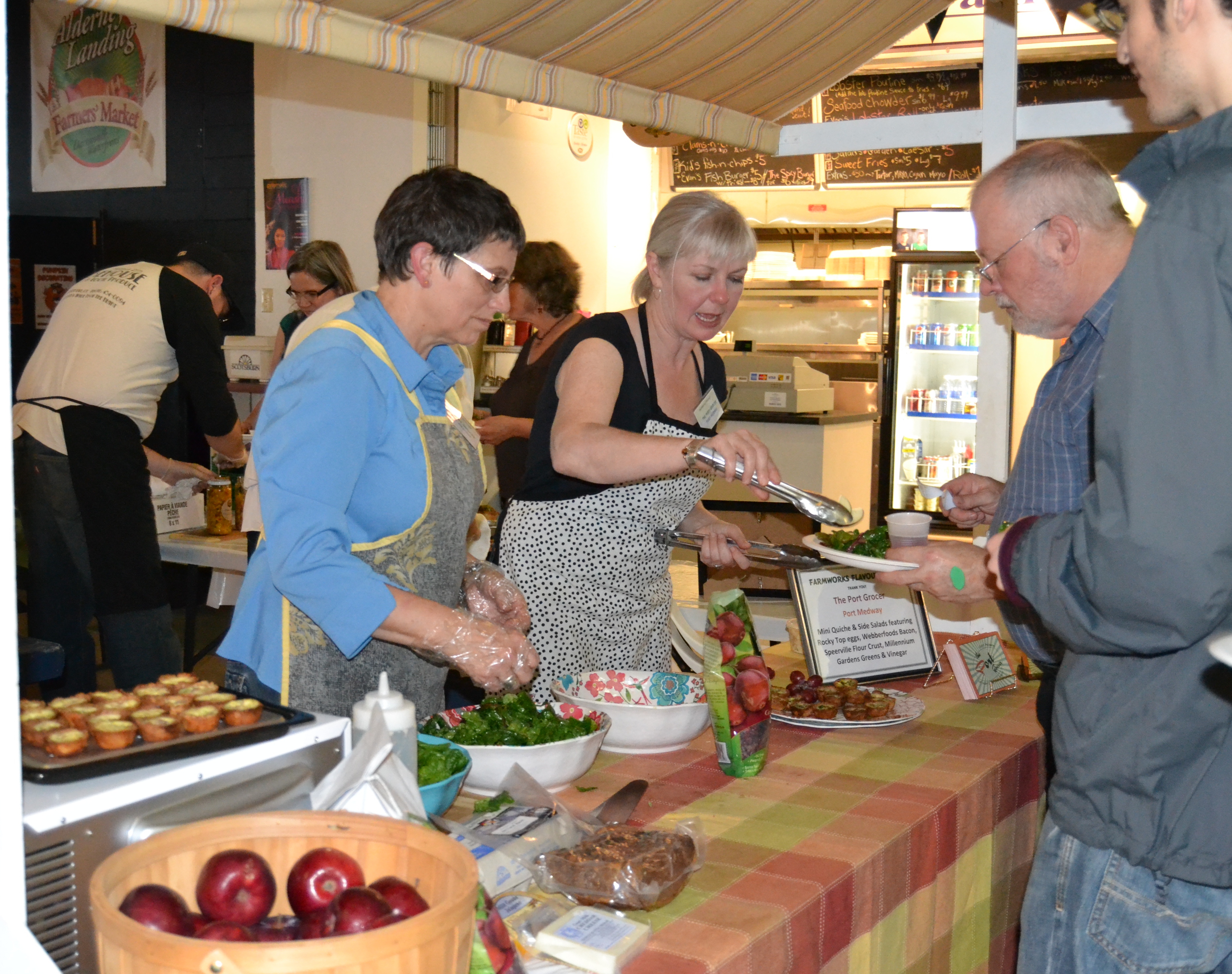
November Flavours – Celebration of Food and Beverage Providers
FarmWorks Investment Co-operative Limited
Healthy Farms, Healthy Food
 Linda
Linda
November Flavours – Celebration of Food and Beverage Providers
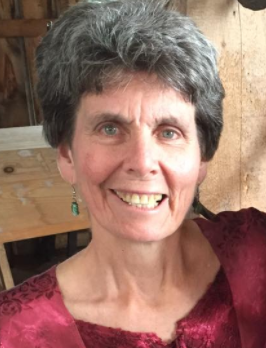
 Ginny Point has a long standing interest in agriculture and healthy food. It started years ago when working at the Ecology Action Centre, with the agriculture committee. She was fascinated by the interconnections between sustainable agriculture, healthy people and a healthy planet. That led to wanting to learn more about the specifics of nutrition, so she enrolled in the School of Nutrition at Acadia University. After graduation, for many years Ginny worked at a dietitian, until her retirement in January 2018. For numerous years she managed the Food Services Department of Kings Regional Rehabilitation Centre, where she made purchasing local food a key priority.
She has been a member of Friends of Agriculture for many years, strongly supporting the Food Summits, and other special events such as the April Flavours. An avid gardener, she and her family grow almost all the produce for the family on their very large and somewhat eclectic garden, on their property at Lorax Woodlands on South Mountain. She is delighted to have the opportunity to join the Board of FarmWorks in 2018.
Fixing food for the health of Nova Scotia
What are we eating? For too many of us, it isn’t Michael Pollan’s prescription: “eat food, not too much, mostly plants”
We’re eating lots of processed foods – highly processed foods – with additives including preservatives, lots of sugar and salt and taste enhancements. These foods are easy to buy and prepare quickly to provide calories. They’re also easy to waste.
Taste buds may accept these foods but our health doesn’t. What we eat can cause obesity and diabetes and heart disease and cancer and overall poor health. And that affects the way we live, work, play, earn – affects our health, determines our future.
There’s good news. When we eat better, we live better.
When we were eating food that was grown, not built to withstand the rigours of a worldwide supply chain; when a tomato was a seasonal delicacy and a potato was stored locally for year-round consumption, rates of food-related illness were much lower. It’s notable that as other countries adopt processed food their illnesses come to mirror those of fast food nations.
We can choose, and eat, and cook our way to better health and a more equitable, sustainable food system. We can find the balance between processed and unprocessed and between locally grown and imported.
Food businesses exist to sell food, which means they follow the trends determined by consumers. If we demand more local vegetables, stores will stock them. If we decrease our consumption of commodity food and buy foods that are grown by people who care about customers and the planet, if we promote policies that encourage local production that supports local economies, if we demand a health care system that fights obesity the way it did tobacco, changes will follow.
Many Nova Scotian farmers and producers are swimming upstream in the global marketplace, not because their food is too expensive, but because many imported foods do not reflect the true cost of production in countries where subsidies permit lower cost of production or where workers may be poorly paid. Loss of income across the food production sector is costing us more than we’re gaining by choosing less expensive food: loss of money that leaves the province to pay for imported food that could be grown here; of employment (many processing plants have closed), of rural residents, of the tax base; of the amenities of the countryside and, importantly, of the entrepreneurial mindset that typifies small and medium size business people who can grow the economy.
But, growing our agricultural and food production sector (farming, transportation, wholesale/retail, processing, preparation) will provide good local food and keep money in the province, thus increasing employment, building social connections and communities, improving individual and the wider determinants of health. These benefits are consistent with the We Choose Now! Directions that follow the One Nova Scotia Report by Ray Ivany et al which noted that “the single most significant impediment to change and renewal is the lack of a shared vision and commitment to economic growth and renewal across our province and among our key institutions and stakeholder communities.”
The 2016 Food Summit on May 28th and 29th at Fountain Commons, Acadia University, sponsored by Friends of Agriculture in Nova Scotia, will address these issues.
We’re pleased you’ve joined us for an informative and inspiring two days of conversations with people who are working to make a difference in the lives of the people who produce and eat food. Sincere thanks to the speakers who are giving generously of their time to help us discover healthy food now and for the future.
Sincere thanks to the Presenters, our Students and FANS Board Members for their ideas and assistance with the Summit.
Linda Best
Chair, Fiends of Agriculture in Nova Scotia
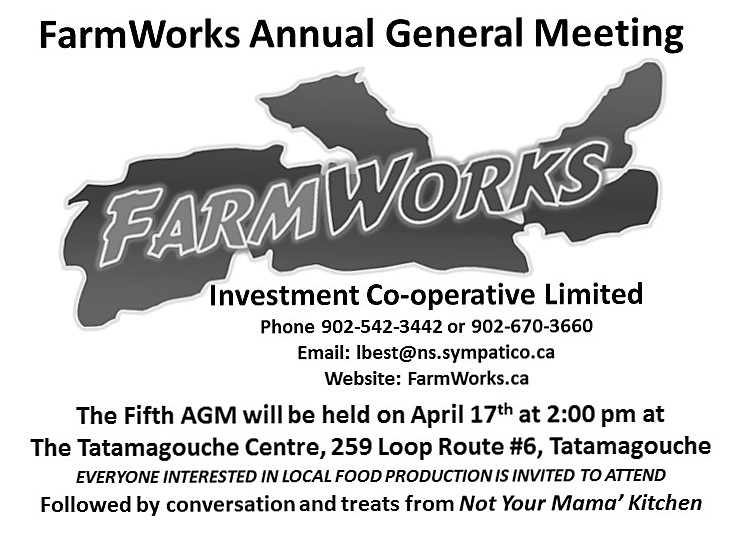
AGENDA – ANNUAL GENERAL MEETING
SUNDAY APRIL 17TH, 2016 AT 2 PM
Tatamagouche Centre, 259 Loop Route 6, Tatamagouche
2:00 pm Registration of Shareholders and Guests
Local treats provided by Not Your Mama’s Kitchen, Pictou
Distribution of Annual Report and Minutes
2:30 pm Guest Speakers – Lil MacPherson and Kirk Rasmussen
3:00 pm Welcome and Introductions
Call to Order
Minutes of 2015 AGM
Business arising from the Minutes
Report on the CEDIF and Investments
Report on the Audited Financial Statements
Appointment of Auditor for next year
Report of the Nominating Committee
Nominations from the floor
Election of New Directors
New Business
4:00 pm Adjournment
Please join us at the Tatamagouche Centre, overlooking beautiful Tatamagouche Bay, which is located at a gathering place that was used for thousands of years by First Nations, and later by the Acadians. For over 50 years Tatamagouche Centre has been a meeting place for those who deeply care about spirituality, leadership, and social justice, and the Centre has touched the lives of thousands of people. Tatamagouche Centre is a leader and innovator, offering over 60 programs each year. We also provide warm hospitality to hundreds of church, community and other organizations as well as offering self-contained, private retreat space.
The Centre’s five residences include rooms that accommodate 27 guests in single rooms or 50 guests in double occupancy. Please check with the Centre if you might consider staying overnight prior to or after the AGM.
FarmWorks is Charting a Path for Growth in Nova Scotia
Shareholders in FarmWorks Investment Co-operative Limited Community Economic Development Investment Fund (CEDIF) are helping to create employment and increase production and profitability in the food sector in Nova Scotia.
The first four FarmWorks CEDIF Offers raised $1,033,400 within 38 months, $1,056,000 has been loaned to 44 food-related businesses, all expenses have been paid and there is $210,000 in the Credit Union. Monthly loan repayments add to the amount available to be loaned to new applicants after exacting due diligence procedures have been completed. Payment by clients of the principle and interest at six percent commences three months after loans are disbursed. No fees are charged for applications or early repayment and Directors and Advisors provide mentoring, networking and promotion. Businesses benefit from FarmWorks capacity to link producers and customers and create a matrix of food supply and multiple points of sale.
FarmWorks was established in 2011 to promote and provide strategic and responsible community investment in local food production and distribution in order to help increase agricultural and related economic activity and provide access to sustainable local food for all Nova Scotians.
Shareholders who chose to hold investments for 15 years in FarmWorks Community Economic Development Investment Fund (CEDIF) will receive cumulative Provincial tax credits of 65% in addition to dividends paid in five year installments. Invested funds are used to provide subordinated debt to farms and food-related businesses. Applicants’ values and goals must align with those of FarmWorks, and diligent review of business plans, financial projections and feasibility by directors and/or advisors precedes any Board decision to lend.. Protection of shareholder investments in FarmWorks is paramount in order to ensure the ongoing operational and reputational success of the CEDIF.
A survey carried out at 18 months indicated that the first 18 businesses receiving loans created 20 full time and six part time jobs in addition to 21 full time and 14 part time positions held in their businesses by the owners themselves. For startup and young businesses roughly 25% of their total capital came from FarmWorks, representing a significant contribution to their businesses. For established businesses, loans accounted for 1.5% to 100% of specific project capital.
Starting in September a student in the Masters in Public Administration program at Dalhousie will be carrying out a survey of the first 36 months of operation to assess the economic, social and other benefits provided by FarmWorks’ investors’ loans to food-related businesses.
FarmWorks is having a significant effect on Nova Scotia’s agri-food sector by strengthening many food and farming businesses. Recognizing that access to high quality local food for people everywhere is a significant challenge, FarmWorks has been keen to support restaurants, and food outlets featuring local products in many of our communities. The networking and trickle-down effects have been remarkable as we have seen demand for local product grow, and new alliances between producers and purveyors of fine Nova Scotia food develop. FarmWorks is helping to chart a path for growth by investing in all facets of local food production and distribution, while improving food security – a key determinant of the health of people, communities, and the economy of Nova Scotia.
FarmWorks’ ability to attract investment into the sector depends on the success of the clients, but also on the growing awareness of the benefits of local food production as a key to community economic resiliency, improved health outcomes, security of food supply and biodiversity. Sustainable food production is fertile ground for investors seeking returns on ethical investments. Over three years of operations FarmWorks has seen interest grow in an investment vehicle that keeps Nova Scotian’s dollars working for Nova Scotians. Our challenge for the future is to reach more and more people who want to invest in our own future. Our immediate goal: to double the total invested in FarmWorks by 2016.
The Centre for Local Prosperity brought a wide range of speakers and citizens together in Annapolis Royal and Cornwallis Park over four days in April 2015 to consider New Economics for Rural Canada.
Conference Keynote speaker, economist Michael Shuman, has written that Americans’ long-term savings in stocks, bonds, mutual funds, pension funds, and life insurance funds total about $30 trillion (America 330 M, Canada 33 M people). But not even 1 percent of these savings touch local small business—even though roughly half the jobs and the output in the private economy come from them. So, how can people increasingly concerned with the poor returns from Wall Street and the devastating impact of global companies on their communities invest in Main Street? Most industrialized countries have set up long-term savings and pension systems that systematically overinvest in global companies and underinvest in competitive local business. About half of U.S. jobs are in small and medium scale businesses, so an efficient capital system would be allocating roughly half our long-term capital—$15 trillion—to them. We’ve got to remove this huge subsidy to global business.
In his upcoming book and at the Conference, Shuman describes three criteria for local prosperity: Maximize local ownership of business; maximize local self-reliance (before seeking participation in the global economy); and grow triple-bottom line businesses. Nurturing local businesses requires Planning for success, People as entrepreneurs, Partners and collaboration, a Purse of local savings, Purchasing from local businesses, and Policymaking to support local enterprises. Shuman singles out FarmWorks Investment Co-operative as one of the Purse examples and says that “Atlantic Canadians may be surprised to learn that their innovations in local investing, such as the Community Economic Development Investment Funds, are inspiring communities throughout North America.”.
A 2011 study from Penn State authored by Stephan Goetz, professor of agricultural and regional economics, showed that per capita income growth was statistically more significantly correlated with small locally owned businesses that tend to generate higher incomes for people in a community than with big, nonlocal firms. “Smaller, locally owned businesses, it turns out, provide higher, long-term economic growth.” According to Goetz, small businesses and startups provide more than just jobs for community members. They also can improve innovation and productivity on a local level and use other businesses in the community such as accounting and wholesalers, while larger businesses develop their own infrastructure. “We can’t look outside of the community for our economic salvation.” Goetz said. “The best strategy is to help people start new businesses and firms locally and help them grow and be successful.”
In another Penn State study in 2013 “We found that for every $1 increase in agricultural sales, personal income rose by 22 cents over the course of five years,” said Goetz. “Considering the relatively small size of just the farming sector within the national economy, with less than 2 percent of the workforce engaged in farming, it’s impressive that these sales actually move income growth in this way.”
According to a 2010 national study by sociologists at LSU and Baylor University, counties and parishes with a greater concentration of small, locally-owned businesses have healthier populations – with lower rates of mortality, obesity and diabetes – than do those that rely on large companies with “absentee” owners. The authors state that “entrepreneurial culture facilitates collective efficacy for a community and provides a problem-solving capacity for addressing local public health problems” said Troy C. Blanchard, Ph.D., lead author and associate professor of sociology at LSU.
Shuman says that “we need a new vision of politics and an abiding commitment from citizens to participate in it. The quality of the sustainable communities depends on the degree and sophistication of citizen engagement. We cannot have sustainable communities built on millions of couch potatoes. People need to step up and take control of their lives for sustainable communities to work.”
Conference Keynote Speaker Marq DeVilliers, author of Our Way Out, said that he has seen enough of the world to know that Nova Scotia is a special place to call home. He states that “economic gardening” – growing small businesses and start-ups built on skills and attributes native to the region – can increase the prosperity of our communities. Farming and fishing are the kinds of skills that create necessary goods closer to consumers, leading to local prosperity.
FarmWorks Investment Co-operative Limited has raised a “Purse” of over one million dollars in three years from Nova Scotians who are convinced that local prosperity is ours to grow. Thirty-five local food-related businesses have already received loans, and by the time the million is disbursed another 15 to 20 community-based businesses will have received loans. FarmWorks’ clients’ successes are confirming the Keynote Speakers’ arguments for investing in local businesses. The increasing appetite for the products of local farms and producers shows that the purse must continue to expand in order to help fund more businesses.
FarmWorks envisions healthy farms, healthy food, and by extension, healthy people and healthy communities. We are helping to build locally owned businesses in communities across Nova Scotia. Investors in FarmWorks and businesses supported by FarmWorks are major contributors to the resilience necessary for a new economy to take root and grow in Nova Scotia. Everything starts with food.
http://www.postcarbon.org/the-latest-trends-in-sustainable-communities/
http://www.sbecouncil.org/about-us/facts-and-data/
http://edq.sagepub.com/content/28/1/5
http://cjres.oxfordjournals.org/content/5/1/149
http://marqdevilliers.com/our-way-out/

NEWS RELEASE FarmWorks Investment Co-operative Limited
For Release March 30, 2015
Funds for Food – FarmWorks is cultivating food producers
FarmWorks has reached its first million! A fourth offer of FarmWorks Shares has raised $312,400 from Nova Scotians interested in supporting food producers and growing the Provincial economy. This brings the three year total to $1,033,400 and to date loans have been granted to 34 businesses across the Province. Funds from the new Offer will be loaned to applicants who meet FarmWorks criteria of excellent business planning, and home-grown production and sales.
FarmWorks Investment Co-operative Limited sells Community Economic Development Investment Fund (CEDIF) Shares to raise capital for strategic and responsible investment in sustainable food production. This capital is loaned to qualifying food-related enterprises that contribute to the Provincial economy by creating jobs on farms and throughout the food system, stimulating the economy, increasing food sufficiency and providing benefits for all Nova Scotians. As loans are repaid the capital is loaned to new applicants.
To date the following businesses have received FarmWorks loans: Pie r Squared, Big Spruce Brewing, Kingsville Farm, Fenol Farm, Stewart’s Organic Farm, Oakview Farm, Meander River Farm, Valley Flaxflour, Meadowbrook Meat Market, Charcuterie Ratinaud French Cuisine, Wandering Shepherd Cheese, Rocky Top Farm, Helen B’s Preserves, Savour Deli, Local Source Market, Gold Island Bakery, Vincent Food Dressings, Good Lake Farm, Field Guide Restaurant, Fruition, Hoppy’s Farm, Millennium Gardens, The Port Grocer, Boxing Rock Brewing, Down on the Corner Farm, Flying Apron Cookery, South Shore Farm, Forever Green Farm, Highland Drive Storehouse, Getaway Farm, Rockwell Local No 9, Meadows’ Brother’s Farm, Loré’s Strawberry Farm, Thousand Hills Farm.
Across the Province FarmWorks hosts Information Sessions for potential investors and Entrepreneurs’ Showcases with “Gentle Dragons” asking questions of entrepreneurs interested in applying for FarmWorks loans. Mentoring and promotion is provided, and annually in October FarmWorks Flavours brings producers together with people who are interested in sampling and learning more about their products.
The fourteen Directors of FarmWorks Investment Co-operative Limited come from across Nova Scotia and, in collaboration with many knowledgeable Advisors, bring expertise in agriculture and food production, economic development, education, health, and business finance and funding decisions.
FarmWorks Share Offers, which require a Certificate of Registration under the Nova Scotia Equity Tax Credit Legislation and non-objection by the Nova Scotia Securities Commission, enable investors who meet the criteria set out in the Legislation to purchase shares in FarmWorks CEDIF and receive a personal 35% non-refundable Nova Scotia Equity Tax Credit. Investors may be eligible for further Tax Credits of 20% and 10% at the 5 and 10 year investment anniversaries. Investments may be eligible for RRSP tax deferral.
FarmWorks Annual General Meeting will take place on April 30th at 3 pm at the Louis Millett Community Centre, Room 119, 9489 Commercial Street, New Minas. In the same location, at 6 pm the annual April Flavours Dinner sponsored by Friends of Agriculture will feature food and beverages provided and prepared by FarmWorks clients and other food producers. Tickets are $40, are required to be purchased in advance, and are available from Linda Best, various local sources and online (details at https://sandbox.farmworks.ca/fans/)
For more information about this press release contact:
Peter Hicklenton or Linda Best
Co-chairs, FarmWorks Investment Co-operative Limited
Phone: 902-542-3442 or 902-670-3660